CASE STORY
Nalara Village, Balikuda Block, Jagatsinghpur District, Odisha | Maa Ugratara Producer Group | FRDP Project
The Village and Its Land
Nalara, in the Balikuda block of Jagatsinghpur district, Odisha, is a farming community whose livelihoods are inseparable from agriculture. But the land here has never been easy to work. Highly fragmented, uneven, and predominantly upland, Nalara’s fields resist the most basic need of any farm: water.
Water is not scarce in Nalara — it is inaccessible. Canals and lift irrigation points exist, but maintenance is erratic, and timely water release is a persistent frustration. During dry months, most upland fields lie fallow. For households dependent on paddy in the monsoon and minimal vegetable cultivation in the off-season, this means months of lost income and deepening uncertainty.
In response to these systemic limitations, a group of 25 women initiated a shift in their approach.
The Intervention: A Solar Pump, A Shared Future
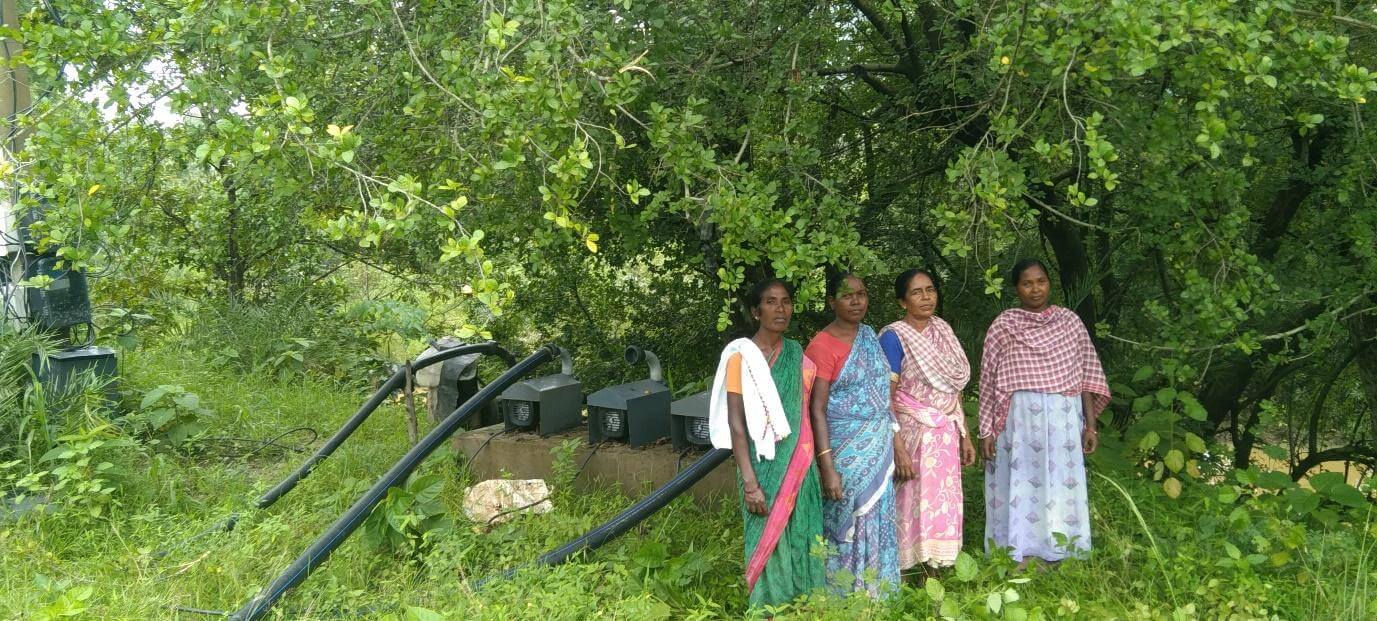
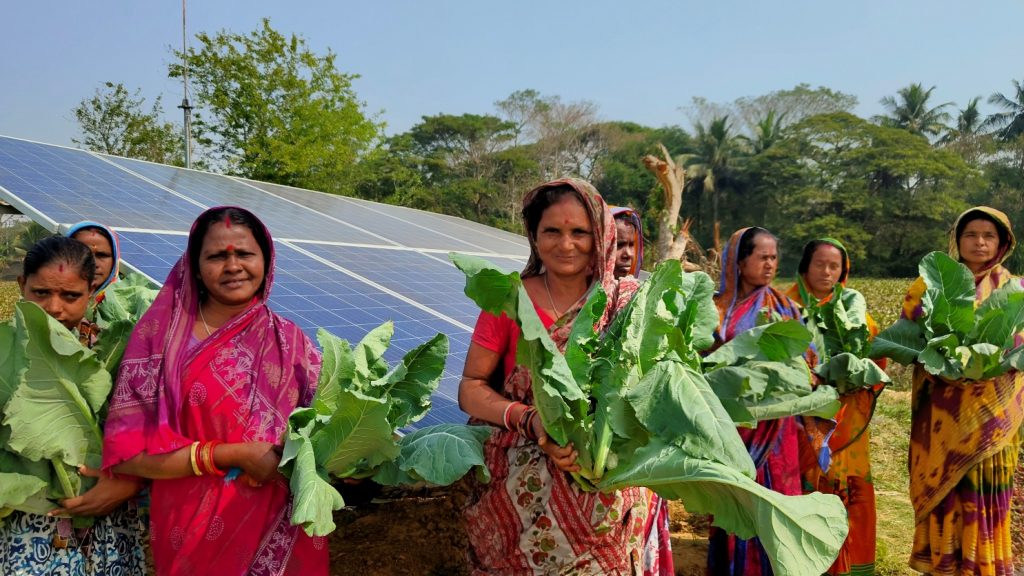
In November 2025, under the Focus Rural Development Project (FRDP) — supported by HDFC Parivartan and implemented by Harsha Trust — the 25 members of the Maa Ugratara Producer Group were collectively entrusted with 3 HP and 5 HP solar-powered irrigation pumps. It was not merely an infrastructure installation. It was a transfer of resources and responsibility into the hands of women who had long been on the periphery of productive decision-making.
Unlike the diesel pumps that previously mediated their access to water, the solar system demands no fuel purchase, no last-minute scramble, and no dependency on pump owners who often prioritised their own fields first. Decisions around water use, cropping patterns, and maintenance are now taken jointly within the group — a shift from individual helplessness to collective agency as significant as the water itself.
The Transformation: Land That Was Once Left Behind
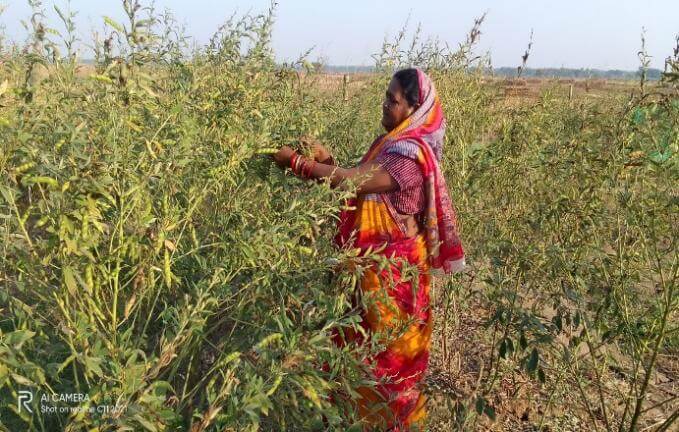
Even before the solar pump arrived, some members were already cultivating small patches of land in the dry season, whatever they could manage with limited and unreliable water access. But the scale was modest, the effort disproportionate, and the returns uncertain. The installation changed that calculus entirely. With assured irrigation now within their control, the women expanded their cultivated area significantly. Land that had largely remained underutilised began to green over in earnest.
Today, nearly 15 acres are under active cultivation — cabbage, cauliflower, potato, tomato, onion, green leafy vegetables, radish, beans, brinjal, coriander, spinach, and methi across 8 acres, with the remaining 7 acres under chilli whose harvest is expected to yield over 3 lakhs.
The income earned from just 8 acres in the Rabi season stands at ₹9,25,000 against a total expenditure of ₹1,35,000 — the result of disciplined collective farming with reliable irrigation.
Income from the Rabi Season (8 Acres)
| Crop | Area (acre) | Expenditure (₹) | Total Income (₹) |
|---|---|---|---|
| Main Crops | |||
| Cabbage | 1 | 18,000 | 1,90,000 |
| Cauliflower | 2 | 35,000 | 2,30,000 |
| Potato | 0.9 | 10,000 | 40,000 |
| Tomato | 0.5 | 8,000 | 30,000 |
| Onion | 0.4 | 3,000 | 10,000 |
| Green Crops | |||
| Green leafy vegetables (Kosala) | 0.8 (×2) | 15,000 | 2,10,000 |
| Radish | 0.5 | 9,000 | 30,000 |
| Beans | 0.6 | 10,000 | 30,000 |
| Brinjal | 0.4 | 7,000 | 45,000 |
| Other / Mixed | |||
| Coriander, Spinach, Methi (mixed) | 0.7 | 20,000 | 1,10,000 |
| Total | — | 1,35,000 | 9,25,000 |
Note: The remaining 7 acres under chilli cultivation are yet to be harvested, with an expected income of over ₹3,00,000.
Taking the Produce to Market
The group benefits from its proximity to several active local markets — Balipatana, Machagaon, Balikuda, and Apandara, among others. The men of the household assist in transporting produce to local haats, while several women take initiative through door-to-door selling within the village. This direct market access reduces dependence on middlemen and keeps more of the earnings within the group.
Holding the Gains: How the Group Manages Its Money
Earning well is one thing. Managing that income with foresight is another — and here the Maa Ugratara group demonstrates a maturity that sets them apart. Profits are not immediately drawn down and spent. Instead, earnings are divided equally among all 25 members and deposited into the group’s collective account, held in common and accessed only when genuinely needed.
Decisions on how savings are used are taken together in group meetings — whether to support a member in need or, more often, to reinvest back into seeds, inputs, and the next crop cycle. Every rupee that returns to the field is a rupee working toward their shared future rather than disappearing into short-term consumption. This model of financial self-governance protects the group against seasonal vulnerability and ensures that the prosperity of one season becomes the foundation of the next.
Beyond the Numbers: Drudgery Reduced, Dignity Gained
Agricultural productivity tells only part of the story. The solar pump has also meaningfully reduced the physical burden on these women. Irrigation previously required long hours of coordination, waiting for turns, and dependence on others — often at critical moments of crop growth.
Earlier, diesel pump use cost approximately ₹200 per hour, on top of fuel at ₹120–130 per litre. Most women did not own pumps and had to borrow, with delays compounded by erratic electricity.
“Electricity in the village is a problem, and buying diesel was an extra burden. I didn’t have a pump — I had to borrow it, wait for my turn, and by the time it came, irregular power had already delayed everything further.”
— Lili Barik, Member, Maa Ugratara PG
The solar pump has eliminated this vulnerability — cutting irrigation costs to near zero, removing grid dependency, and returning time and energy to better farm management and household life.
Recognition and Support
The dedication of the group has not gone unnoticed. Recognising the scale and quality of their cultivation, OLM (Odisha Livelihood Mission) extended a subsidy of ₹2,40,000 — twice — to support their initiative. The group is also planning to acquire a power tiller, with Harsha Trust committed to supporting this next step in farm mechanisation.
The Way Forward
The fields of Nalara are no longer defined by what they lack. They are defined by what 25 women have made possible — through collective work, shared ownership, and the reliable energy of the sun. Looking ahead, strengthening government convergence through agriculture and horticulture departments, extending market linkages beyond local haats, and introducing farm mechanisation are the priorities that will determine how far this progress travels.
Their experience holds lessons well beyond this one village. Decentralised renewable energy, in the hands of organised communities, does not just solve a technical problem — it redistributes power over resources, decisions, and futures.
Supported by HDFC Parivartan & Harsha Trust | FRDP Project | Jagatsinghpur, Odisha